Every week, another headline laments the “talent shortage” or wonders why qualified candidates are seemingly vanishing into thin air. Businesses are spending thousands on job boards, rewriting descriptions, and scratching their heads over empty application pipelines.
They ask: Where are all the good candidates? Why aren’t they applying?
Employers desperately need to come to terms with the fact that what they are advertising, and why they are not getting the right people applying for their jobs, is because they are missing the fundamental reason for these people to apply, which is why?
But we know this right? The salary is there, the role is there, the two-paragraph spiel about how successful the company is, is there… and that is about 99% of job adverts on the internet right now.
That’s why, you’re a good company, it’s a good salary, it’s an “exciting opportunity”
But the people you want are still not applying? The ones who can hit the ground running, and not the applications you are currently getting and rejecting.
And I hear that word a lot – “we need the ones that can hit the ground running” – which means, comes in does the job.
But the why, isn’t always – the salary, the job, the company – it’s something always missed by employers, and why employers lose good people on the other side of that fence too.
And you’re right in thinking – “Ok, I have to convince the reader that what I have is better than what they have got, let’s resonate their motivation to leave?”
In part, that is correct. But to meet the motivation to leave, you usually need to be able to get the person in front of you and discover that in an interview. You can’t do that if they never apply in the first place.
No, what you need to understand before they even apply is the Known Nonsense either in general – in your sector, your market, and the specific type of role your ideal candidate is currently sitting in. And you genuinely have to be better than that – for them to consider.
Once you do that, then they will find the motivation to apply, and if employed, potentially leave their role.
“Hang on, what is this Known Nonsense? Sounds like Nonsense”
It’s a weird term, right? But it is a massive, unspoken reality in the job market today.
Gallup’s UK workplace data puts employee engagement at around 10%. That doesn’t mean 90% of people are miserable or desperate to resign, but it does suggest most people are not emotionally locked into their current employer.
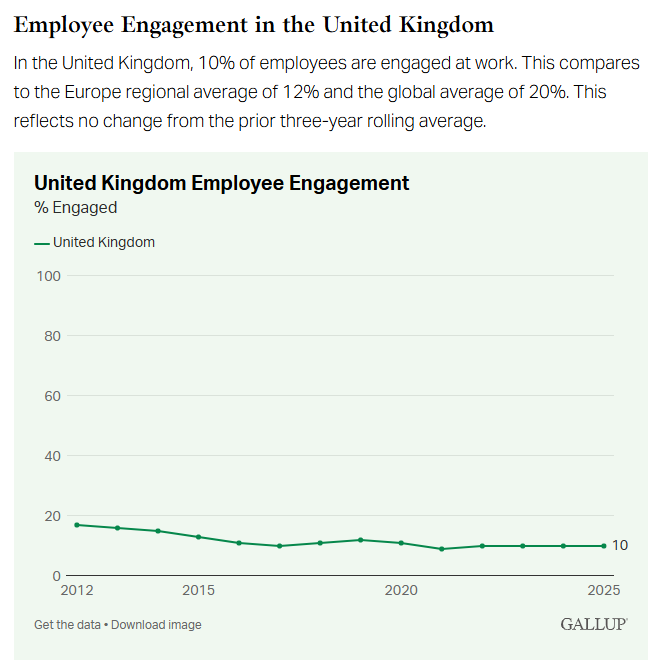
But here you are, with a role advertised, and your inbox is either very quiet or full of applications that don’t meet the brief.
Where are all the candidates you actually want to hire? Especially if these polls are saying people are all unengaged in their jobs? Shouldn’t they be looking to leave.
They are. Passively. On their terms. Nearly half the market – do believe its a good time to leave their jobs
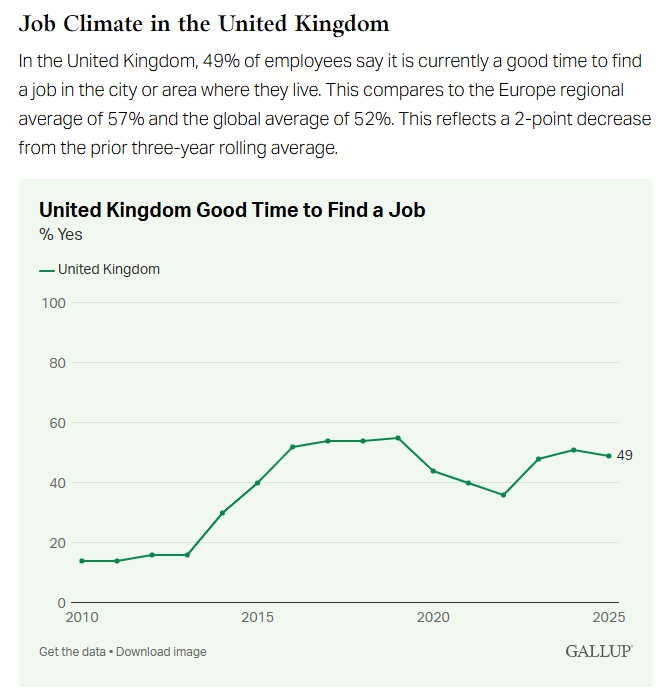
They’re not engaged, most believe its a good time to leave a role, but 51% don’t (that’s important to highlight) and even among those who are open to moving, being open is not the same as applying.
So what is happening? A lot of it, is putting up with the Known Nonsense in their current role.
They feel moving jobs to something similar isn’t worth the anxiety. And potentially they don’t see the role you advertised as being any better than where they are, and they probably won’t apply, unless they are facing an immediate crisis, like redundancy.
It doesn’t mean the role you are advertising is poor or bad, or that you’re deemed a bad employer. It just means they don’t see themselves in that role because it’s the exact same noise, they are already sitting in.
It’s why a lot of people accept counter-offers at the eleventh hour, too. Remaining where you are means zero friction.
The Psychology of “Better the Devil You Know”
In psychology and economics, this is driven by what’s called Status Quo Bias and Loss Aversion.
Psychologists have proven that the pain of losing a predictable routine is twice as powerful as the pleasure of gaining something new
Known Nonsense can be everything or anything that makes a person feel safe, where the anxiety of daily life is lower.
I come across this constantly when headhunting candidates, highly practical, real-world things that are never on a job spec, but are the genuine reasons people won’t leave their current setup.
Honestly, I hear everything from: “Oh, that company is on the other side of the M32 in Bristol, yeah, the end of that road is a nightmare to go down at 7:30 AM.”
As an employer, you’d be thinking, “Well, just set off 30 minutes early.” But you are forgetting that people have kids, childcare drop-offs, or partners who work nights, and they only have one car.
In that same vein, I’ve heard people ask if there is parking, because some companies don’t have it, or it’s a fight to get a space outside the office, and it will cost them £10 to £15 a day out of their own pocket, completely wiping out any small salary increase that maybe offered.
People have asked me all sorts of questions, right down to: “Is it a laptop or a PC I will be working on?”
To an HR manager, that sounds trivial. But to a top candidate, it matters immensely. Technology stack can be a make or break some good people – how relies on it for success.
Everything from – If there is flexibility to work from home seamlessly if a child wakes up sick. It tells them if your company invests in modern tools or if they are going to spend their first three weeks fighting with an IT department over a sluggish desktop tower from 2018.
And that is just the computer. People ask “can I leave at 5pm” – or is it one of those jobs, you leave when the boss leaves.
They tolerate the flaws in their current job because they have built up “social capital.”
Their current boss trusts them, or an understanding they are 10 mins late, because of child care or traffic, or the trains or they like to start at 10am – because they are training in the morning for a triathlon (true story) – or they can slip out early for a dentist appointment, and they know how to navigate the office politics. Moving to your company resets that safety meter back to zero.
Then there is the Elephant in the Room: The Predictable Workload vs. The Poisoned Chalice
We often forget that the reason a role is live on the external market is because it is normally the job nobody internally wants or someone has left, sacked, or other – or nobody is qualified for.
Everyone knows this. Or better still, this is what people presume, in the absence of information. They know how the corporate world works.
In their current role, their workload is predictable. They have developed the scar tissue to handle their current boss’s quirks and their current company’s mess. They know how to pace themselves so they can still switch off at 5:00 PM.
They know their job, and sometimes for anyone trying to find someone like them – they know the nuances, pitfalls and poisoned chalice.
When you ask them to apply to a generic job advert that looks exactly like 99% of the internet, their brain automatically fills in the blanks with worst-case scenarios. They assume your “fast-paced, dynamic environment” is just code for an understaffed, chaotic mess – Because let’s be honest, the internet, and social media people – have spoiled this old hat language now – that describes the work environment we have.
We all know now, a good work environment – wouldn’t describe its self as fast paced, or dynamic or any other works to that affect.
You are asking them to trade their highly predictable, managed pain for your unknown, potentially catastrophic chaos. And on paper, you haven’t given them a single good reason to take that risk.
How Can you, Flip the Script
If you want the best people to disrupt their safe routine, your job advert cannot just be a list of what you want from them. It has to address the unspoken questions they are asking about you.
And it really starts with, not worrying about describing who you are, at the top of adverts, or website or literature – but it paints a picture of the environment and working conditions.
- Address the logistics: Mention the parking. Be honest about the traffic bottlenecks. And if there are, how can you solve it? Have solutions for current and future staff? Or if there are solutions – mention it. But be honest – free on-site parking is great, if they can access it, and its not 100 cars in 14 spaces.
- Define the flexibility: Don’t just say “hybrid options.” State the exact expectations so they can calculate their childcare, or synergy with their life, partners – future.
- Kill the “Poisoned Chalice” fear: Be radically honest about why the role is open. If you have a legacy system mess that needs fixing, own it. Top candidates love solving real problems, but there needs to be a safety net if they fail, and not the exit and their P45.
And that is why a lot of candidates are quite happy to stick than twist.
People look at jobs today, not just as a career move, but a lifestyle integration, not just an exchange of labour for a pay check. Especially if you want the best or the right candidates.
Resonate their Known Nonsense – and you may see people come forward, you haven’t seen yet.
NB – you might be forgiven to think, that what I am telling you here is to fill the advert with nice fluffy things that will get the right candidates applying that goes against the current flow of business.
No, it’s not what I am saying. I am suggesting that – you need to be aware that the market is watching, and seeing what you have, and comparing their own world with a possible one with you, but with the added anxiety of applying, interviewing, and being offered what they want, THEN adapting their lives to a new nonsense.
That is a big move for a lot of people.
What I am saying though, is that you need to check the current offering, is something that today’s market is happy to apply for. Especially I have made you aware that the right people, are sitting still, until the right role comes along – and its more than just money, and career opportunity.
And you may need to look internally to see what needs to either be changed, updated, added, offered – or just simply removed.
And it might be as simple as that.
Or it could unravel a big complex situation – but open the door to growth and opportunity.
What ever that is, jobs don’t get filled by just people.
Jobs don’t get filled by just the right people. They get accepted by people with lives, hopes, dreams, worries and anxieties, and more often than not, all of these things loudly decide their career moves for them, over salary, role and the company.