You have a decent job, a sensible salary and a business you are proud of. You put the advert out. Then you wait.
Where are all the good candidates? Why aren’t they applying?
Sometimes the answer is sitting in another engineering business, doing much the same job, putting up with a collection of things they already know how to manage. I call it the Known Nonsense.
Your job might be better. But have you given them enough information to believe that moving is worth the disruption?
What I mean by the Known Nonsense
Nobody has a perfect job. People get used to the traffic, the workload, the manager’s quirks and the way decisions are made. They know which problems matter and which ones will have disappeared by Friday.
They also build a life around the job. The school run works. Their partner’s shifts work. They can get to the dentist without it becoming an international incident.
That does not mean they are delighted with every part of their working day. It means they understand the arrangement. Your “exciting opportunity” is asking them to trade that for something they do not yet understand.
Being open to a conversation and deciding to apply are different things.
Low engagement does not mean everybody wants to leave
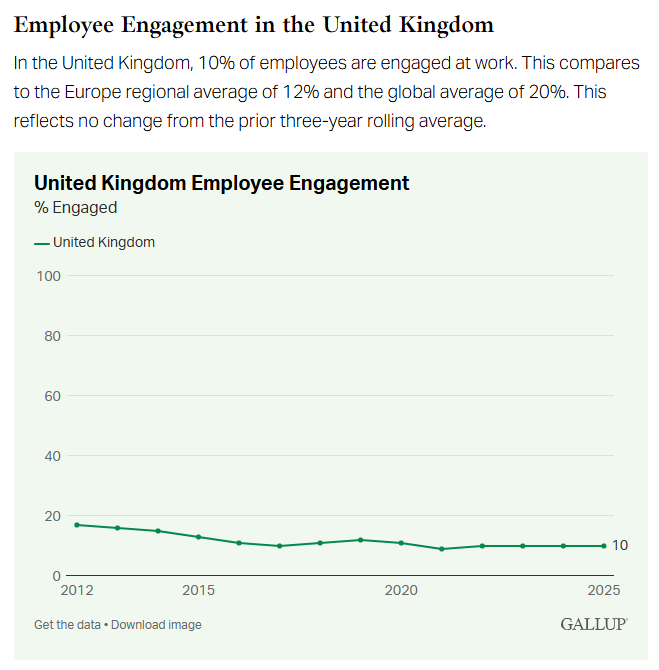
The UK country page for Gallup’s 2026 State of the Global Workplace report puts engagement at 10% in the three-year rolling average ending in 2025. That does not mean the other 90% are miserable or about to resign.
The same page says 49% thought it was a good time to find a job in their local area. That measures their view of the job market, not their intention to leave. It certainly does not tell us that the remaining 51% have decided to stay.
Those are useful distinctions. Neither chart tells you why a particular engineer has ignored your advert. You still need to find that out.

The questions that never make it onto the job specification
I come across this constantly when headhunting. Practical, everyday things that decide whether someone will even consider the conversation.
I have heard: “Oh, that company is on the other side of the M32 in Bristol. The end of that road is a nightmare at 7:30.”
The easy response is “leave half an hour earlier”. Lovely. Except there may be children to drop off, a partner working nights or one car between them. You are looking at a journey. They are looking at whether their morning still works.
People ask about parking too. Is there actually a space, or does “parking available” mean joining a daily fight for the last one? I have heard concerns about paying £10 to £15 a day. That can take a fair bite out of a modest pay rise.
I have even been asked whether somebody will be working on a laptop or a PC. It sounds minor until you understand what they need to do, which tools they rely on and whether work can be done somewhere else when necessary.
Then there is “Can I leave at five?” A reasonable question. Is that the finish time, or does everyone wait until the boss leaves?
Trust and routine have value
Their current manager may understand the childcare arrangement or the awkward train connection. They may have earned enough trust to move an appointment without explaining themselves three times.
I have also spoken to someone whose working arrangement allowed a 10am start because they were training for a triathlon. True story. What looks like a small detail from outside can be quite important to the person living it.
A move means finding out whether any of that will work again. Familiarity can outweigh an apparently better opportunity. I do not need to attach a supposedly universal psychology multiplier to that; I hear the practical concerns in conversations with candidates.
It can also help explain why somebody considers a counteroffer. Staying may feel easier. That does not make every counteroffer sensible, or every candidate’s decision the same.
Explain why the vacancy exists
In the absence of useful information, candidates can fill in the gaps themselves. And their version may be less flattering than yours.
Why is the job open? Is the company growing? Has someone moved on? Is there a difficult project, an inherited system or a team that needs rebuilding?
None of those automatically makes it a bad job. But “fast-paced, dynamic environment” does not explain what somebody will actually inherit. To a person who has already worked through chaos, it may sound like more of the same.
An externally advertised vacancy is not proof that nobody internally wants it. There are plenty of ordinary reasons to recruit. Explain yours without sharing private details about the person who previously did the job.
Good engineers may enjoy a difficult problem. They still need to know what support, authority, time and resources they will have to solve it.
Give candidates something concrete to consider
Start with the reality of the working day. Explain the hours, location, travel and on-site expectations. If there is flexibility, say what it means in this role. If there is not, say that too.
Be accurate about parking, equipment and working arrangements. Free parking is not much of a benefit if there are 100 cars competing for 14 spaces.
Describe the work and the reason for hiring. What needs improving? What is already working? Who will manage the person, and what will a successful first few months look like?
Then check whether the offer needs improving rather than merely describing more enthusiastically. You cannot write your way around a working arrangement that rules out the people you want.
For the practical work behind this, use my pre-job creation checklist and the guide to writing job specifications and adverts. The job-offer guide is useful when it comes to confirming the details a candidate has been weighing up throughout the process.
You are recruiting a person with a life
I am not suggesting you fill the advert with fluffy benefits or promise arrangements the business cannot deliver. That will catch up with you quickly enough.
I am suggesting you understand the decision you are asking somebody to make. A job move can affect their family, routine, confidence and sense of security, as well as their salary.
And being employed is not a badge of superior ability. This article is about why somebody already in a job might stay there. It is not a reason to dismiss an equally capable person who is available now.
If good people are looking and deciding to stick rather than twist, ask what they can actually see in your offer. It may need a clearer explanation. It may need a change inside the business.
Either way, “exciting opportunity” is doing rather a lot of heavy lifting.
If you want to work through the offer before approaching the market, start with the Employer Recruitment Pack. If you are still struggling to explain why the right engineer should move, talk to me about the vacancy.